Chemistry Students Put Enga’s Traditional Salt to the Test
On 9 August 2026, six Year 4 Chemistry students in Environmental Chemistry (SCH442) travelled to the Yokonda Salt Pond in the Pilikambi LLG of Laiagam District to collect traditionally made Enga salt and bring it back to the IUE laboratory for analysis. The trip was led by Dr. Hefa Kemung, Associate Professor of Chemistry, with Mr. Eddie Maxson.
A Traditional Process, Seen First-Hand
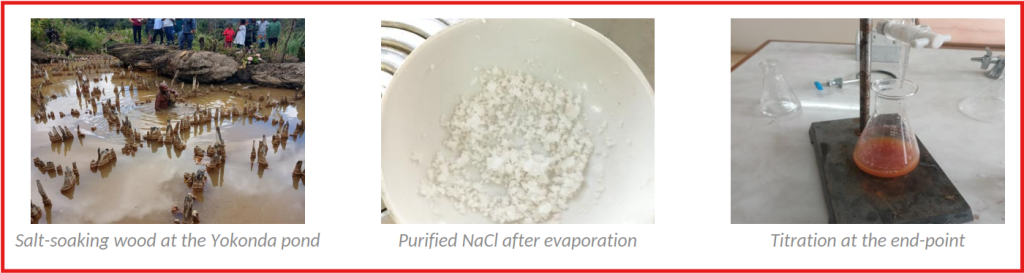
The Yokonda people have produced salt from the pond for generations, long before commercial salt reached Papua New Guinea. Community members demonstrated the process for the students: lengths of wood are left to soak in the saline pond, then dried and burned, and the salt-laden ash is collected and processed into the grey salt sold in packets at the site. Each student wrote a field report on the method, which was assessed as the course’s first assignment.
From the Pond to the Lab
Purification. Back at Irelya, students dissolved weighed portions of the salt, removed the dirt and insoluble matter, and carried out a series of reactions to remove the other salts present, leaving a sodium chloride (NaCl) solution. This was evaporated to dryness, and the recovered salt was weighed to calculate percent yield.
Analysis. Students then measured the NaCl content of 1 g of their purified salt using Mohr’s method, a classic argentometric titration. The sample is titrated with silver nitrate of known concentration, using potassium chromate as the indicator. Silver chloride precipitates first; once all the chloride has reacted, the next drop of silver forms red-brown silver chromate, and the solution turns from yellow to orange-red. From the volume of titrant used, students calculated how much of each gram of Enga salt is sodium chloride.
Course: SCH442 Environmental Chemistry, Year 4 Chemistry
Field site: Yokonda Salt Pond, Pilikambi LLG, Laiagam District
Laboratory 1: Purification of Enga salt and percent yield
Laboratory 2: NaCl content by Mohr’s method (argentometric titration)
Assessment: Field report and two laboratory reports, submitted through Moodle
The exercise took students through the full cycle of analytical work, from field sampling to purification to quantitative measurement, on a material with deep roots in their own province.
Innovative University of Enga | Irelya • Sopas • Akom

You may also like

CALL FOR EXPRESSION OF INTEREST Design & Construction Contractors

The Adoption of New Student Information System from Academia